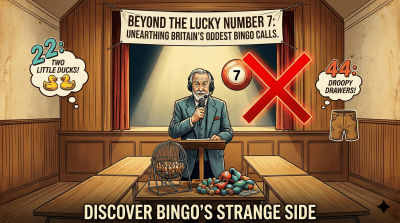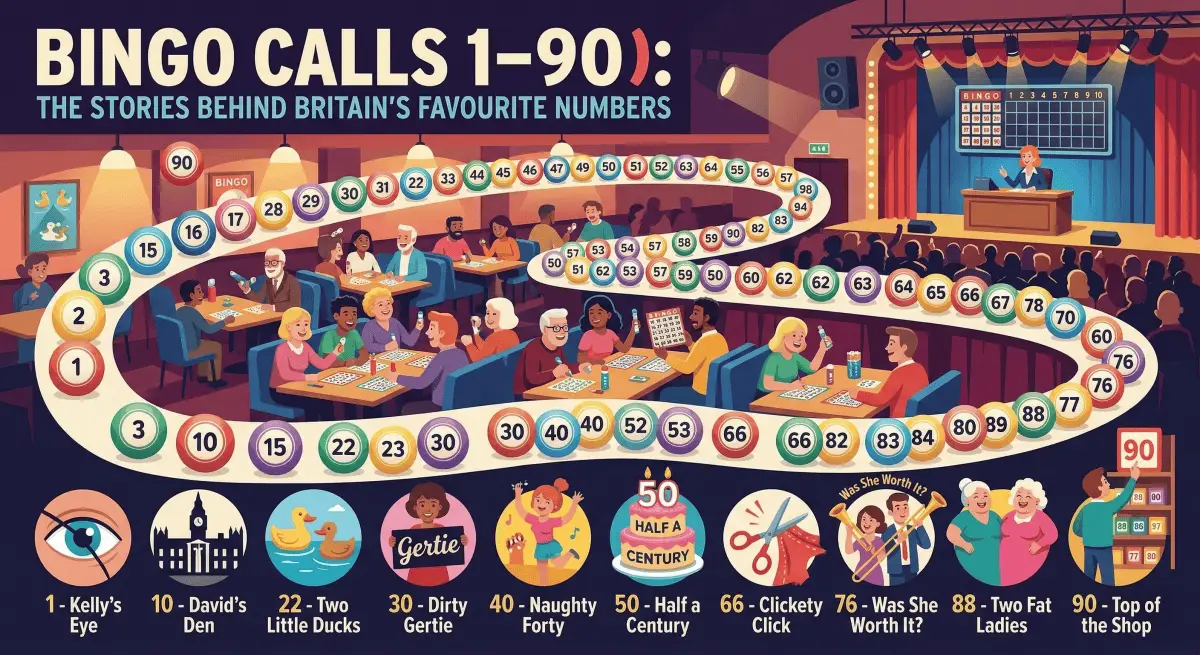
There is a moment, unique to British bingo halls, when the caller picks up the microphone and the room goes quiet. It doesn't matter if you're in a seafront amusement arcade in Skegness or a church hall in Stockport — that hush is the same everywhere. And then the call comes.
Kelly's Eye. Two Little Ducks. Legs Eleven. Two Fat Ladies. Top of the Shop.
These phrases are woven into the fabric of British popular culture. They began in the working men's clubs and holiday camps of the early 20th century, spreading through coastal resorts, community halls and seaside arcades until they became, quite simply, part of the language. Most British adults, whether they've set foot in a bingo hall or not, can complete the sentence 'Two Little...' without thinking.
The calls are a living archive of British humour, history and cultural memory — referencing everything from Old Testament psalms and army medicine to Heinz ketchup and Danny La Rue. Some are centuries old; others were coined to reflect the TV programmes and celebrities of a particular decade. Many have changed over time, swapping one Prime Minister for another, or gently retiring a phrase that's worn out its welcome.
This is the complete guide to all 90 UK bingo calls, their traditional names, their meanings, and the stories that gave them life. Whether you're a caller looking to brush up your patter, a newcomer wanting to know what on earth 'Doctor's Orders' means, or simply a lover of British cultural curiosities, you're in the right place.
Eyes down. Let's go.
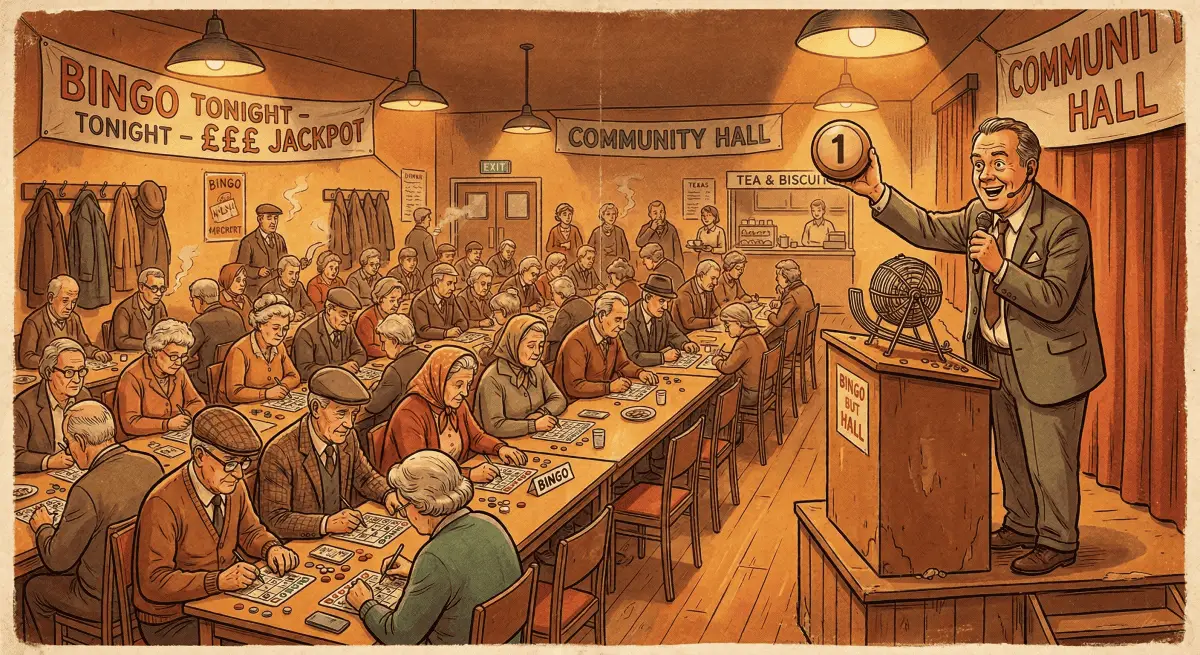
The First Call, Kelly's Eye
Numbers 1–9: The Opening Calls
Every game of bingo begins the same way, a hush falls over the hall, the caller straightens up, and number one gets its moment. The opening nine numbers may be the smallest, but their calls carry some of the most vivid imagery in the whole game. From the mythical one-eyed outlaw to the fattest of ladies, bingo's early numbers set the tone for everything that follows. These calls didn't emerge from nowhere; most were born in the smoky working men's clubs and seaside halls of 20th-century Britain, where humour, rhyme, and a touch of cheek were all part of the entertainment.
1 Kelly's Eye
The solo opener, always called alone. Named after the infamous Ned Kelly, the Australian bushranger whose iron helmet had a single eye slit. One stands apart, and so does this call.
2 One Little Duck
Look at a 2 on its side and you'll see it, a neat little duck gliding across a pond. Simple, visual, and universally loved. Callers often add a soft 'quack' for good measure.
3 Cup of Tea
Pure rhyming slang, and very British. Three rhymes with tea, and nothing says Britain like a good brew. Some halls use 'Goodness Me' or 'You and Me' as alternatives.
4 Knock at the Door
Four rhymes with door, and the image is wonderfully domestic. In some regions you'll hear the caller rap the podium twice as they call it, miming the knock.
5 Man Alive
A classic exclamation from another era. Five rhymes with alive, and the phrase captures a sense of mild surprise, perfect for the game's early, anticipation-building moments.
6 Tom Mix / Half a Dozen
Tom Mix was one of Hollywood's earliest cowboy stars. His name rhymes with six, and he was enormously popular in 1920s and 30s Britain. Younger audiences tend to hear 'Half a Dozen' these days.
7 Lucky Seven
Seven's reputation for luck crosses cultures and centuries, from ancient mythology to modern slot machines. In bingo, it's always announced with a little extra emphasis, as if the number itself brings good fortune.
8 One Fat Lady
The figure of an 8 standing upright does look rather like a rounded silhouette. One of bingo's most enduring visual calls, though some modern halls have gently updated the language.
9 Doctor's Orders
In the British Army, the number nine pill was a catch-all laxative prescribed for everything from a cold to low morale. A brutal little cure that gave this number its permanent place in bingo folklore.
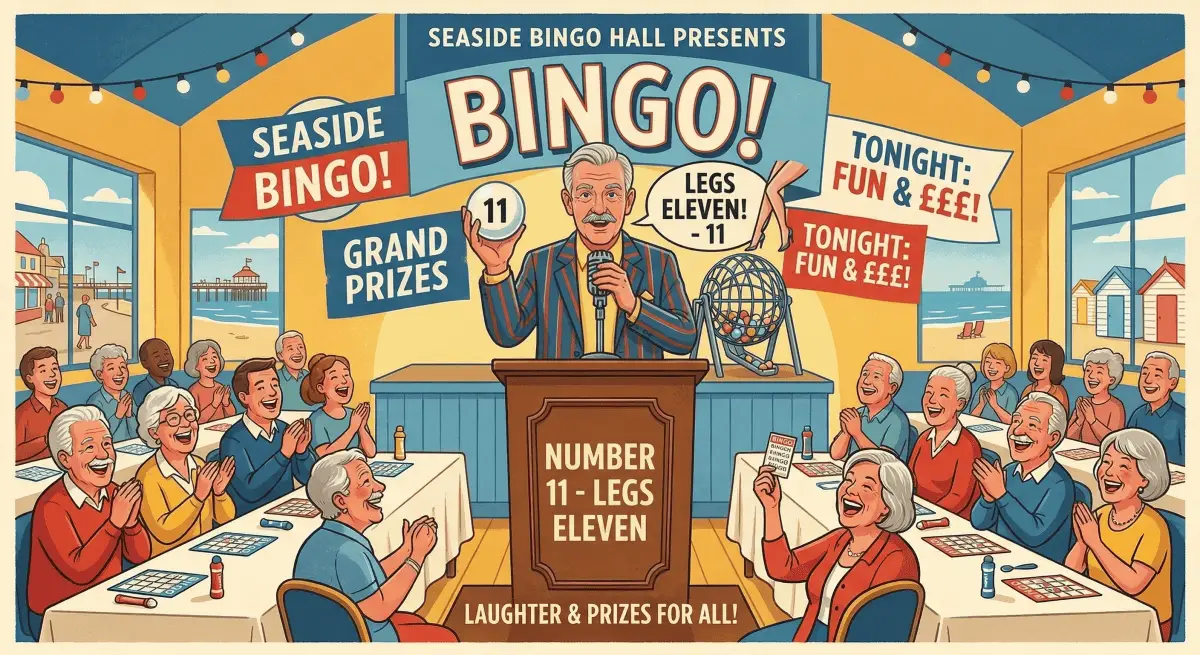
Legs Eleven, A Classic Crowd Moment
Numbers 10–19: The Teenage Years
The teens are where bingo calls start to show their cultural depth. Number 10 nods to the most famous front door in the country, while 13 carries the weight of centuries of superstition. The teenage numbers also include some of the game's most crowd-pleasing moments, Legs Eleven reliably produces a cheer, and Sweet Sixteen always gets a smile. These are the calls that remind you bingo isn't just a numbers game; it's a running commentary on British life.
11 Legs Eleven
The two ones side by side look like a pair of legs. One of the game's most celebrated calls, traditionally accompanied by wolf-whistles, though today's callers tend toward appreciative cheers and a knowing wink.
12 One Dozen / Monkey's Cousin
A simple dozen, or the rhyming slang version. Monkey's cousin is a gentle absurdity that gets a laugh, especially from children playing for the first time.
13 Unlucky for Some
The most hedged call in bingo. Thirteen's reputation for bad luck is ancient and cross-cultural, so callers acknowledge it with a dramatic pause and a cautionary tone, just in case.
14 Valentine's Day
The 14th of February gives this number its romantic associations. Some callers add a theatrical sigh or a blown kiss. It's the one number that reliably makes couples glance at each other.
15 Young and Keen
Rhymes cleanly with fifteen and captures a certain youthful energy. You'll occasionally hear 'Rugby Team' (fifteen players a side) in sporting company.
16 Sweet Sixteen
The traditional coming-of-age phrase, sixteen being the age at which, historically, a great deal of British life changed. Always called warmly, with a smile.
17 Dancing Queen / Often Been Kissed
ABBA's 1976 hit gave this number a pop culture makeover. 'You are the dancing queen, young and sweet, only seventeen', the audience often joins in. A guaranteed crowd-pleaser.
18 Coming of Age
The legal threshold for voting, drinking and independence in the UK. Called with a mix of celebration and mild warning, depending on the caller's temperament.
19 Goodbye Teens
The last of the teenage years, called with a knowing tone. There's something poignant about it, whether you're nineteen or eighty-nine.
Two Little Ducks, The Call Everyone Waits For
Numbers 20–29: Scoring and Milestones
The twenties are all about landmarks. A score, a key of the door, the two little ducks that always get the biggest reaction of the game, this run of numbers is dense with tradition. Twenty-one carries the emotional weight of a coming-of-age moment that entire families once built celebrations around, while the twenties more broadly reflect the era when these calls were being coined: post-war Britain, working men's clubs, coastal amusements, and a national taste for gentle wordplay.
20 One Score
A score is twenty, the unit Shakespeare used in 'four score and seven years', the measure of a good innings. Clean, mathematical, and slightly old-fashioned in just the right way.
21 Key of the Door
For generations, your 21st birthday meant being handed the symbolic key to the family home, the moment you officially became an adult. The call still carries warmth for anyone who grew up with that tradition.
22 Two Little Ducks / Quack Quack
The undisputed fan favourite. Two 2s side by side, two little ducks on a pond, and a room full of players quacking along. If you've ever been to a British bingo hall, this is the moment that stays with you.
23 The Lord's My Shepherd
Psalm 23 is one of the most recited passages in British religious life. The call is delivered with a certain reverence, or, depending on the caller, a gentle irreverence.
24 Two Dozen
Straightforward arithmetic. Twenty-four equals two dozen. Some callers add a quick 'eggs' for clarity, as if ordering from a market stall.
25 Duck and Dive
Rhyming slang that doubles as a description of bingo strategy, though of course there is no real strategy, just hope. 'Duck and dive' as a phrase means to dodge and weave through life's complications.
26 Pick and Mix
Pick and mix sweets were a British institution, the Woolworths counter piled high with cola bottles and foam shrimps. The rhyme works perfectly, and the nostalgia is built in.
27 Gateway to Heaven
Rhymes loosely with seven, and the spiritual echo gives it a certain grandeur. Some callers deliver it with genuine gravitas; others with one raised eyebrow.
28 In a State / Over Weight
Rhyming slang with a dash of self-deprecating British humour. 'Twenty-eight, in a state' is the kind of call that gets a knowing laugh from a room full of people who've had those days.
29 Rise and Shine
Rhymes with twenty-nine, and the phrase carries the brisk optimism of a morning alarm you didn't want to hear. Callers often say it with exaggerated cheerfulness.
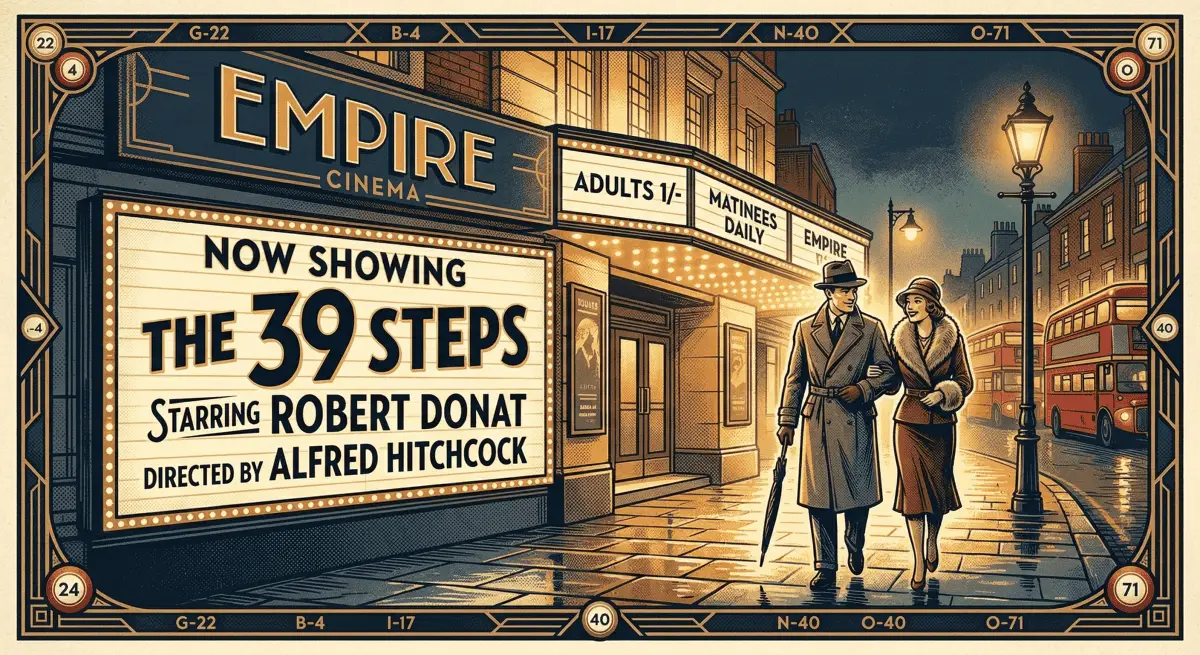
The 39 Steps, Cinema and the Bingo Hall
Numbers 30–39: The Rhyming Thirties
The thirties are where bingo's love of rhyme really hits its stride. Dirty Gertie, Buckle My Shoe, the 39 Steps, this is a decade of numbers with strong personalities. The thirties also reveal the deep roots of these calls in working-class British culture: nursery rhymes, music hall catchphrases, and wartime humour all make an appearance. Thirty-nine is a particular favourite, Alfred Hitchcock would have been quietly pleased.
30 Dirty Gertie
Gertrude, affectionately shortened to Gertie, was old British slang for a woman of questionable virtue. The call is delivered with a theatrical leer that's more pantomime than anything else. Great fun in the right company.
31 Get Up and Run
Rhymes with thirty-one, and the instruction has a slightly panicked energy, as if someone has just spotted the caller about to announce their number before they're ready.
32 Buckle My Shoe
From the nursery rhyme 'One, Two, Buckle My Shoe'. The familiar rhythm makes it satisfying to hear and easy to remember. Callers sometimes say the whole line: 'Thirty-two, buckle my shoe.'
33 Two Little Fleas / Dirty Knees
Two 3s suggest two small crawling things, hence the fleas. 'Dirty knees' is the earthier alternative, rhyming cleanly and getting the predictable groan from an audience.
34 Ask for More
Rhymes with thirty-four. The phrase evokes Oliver Twist's famous request, and there's something appropriate about it, bingo players always want more numbers called.
35 Jump and Jive
Rhymes with five. The jive was the energetic American dance that swept Britain in the 1940s and 50s. This call has a certain swing-era optimism to it.
36 Three Dozen
Thirty-six is exactly three sets of twelve. The mathematical simplicity is satisfying, especially for callers who like a clean, unambiguous announcement.
37 More Than Eleven
A slightly unusual call, descriptive rather than rhyming. Thirty-seven is indeed more than eleven, which tells you very little but is oddly endearing. Some halls use 'Dirty Dozen Plus One'.
38 Christmas Cake
Rhymes with thirty-eight, and the association is entirely festive. Best deployed in December for maximum effect, though seasoned callers use it year-round without apology.
39 Steps / The Famous Steps
Alfred Hitchcock's 1935 thriller The 39 Steps gave this number its cinematic glamour. The call is almost always delivered with a dramatic pause, thirty-nine... the steps.
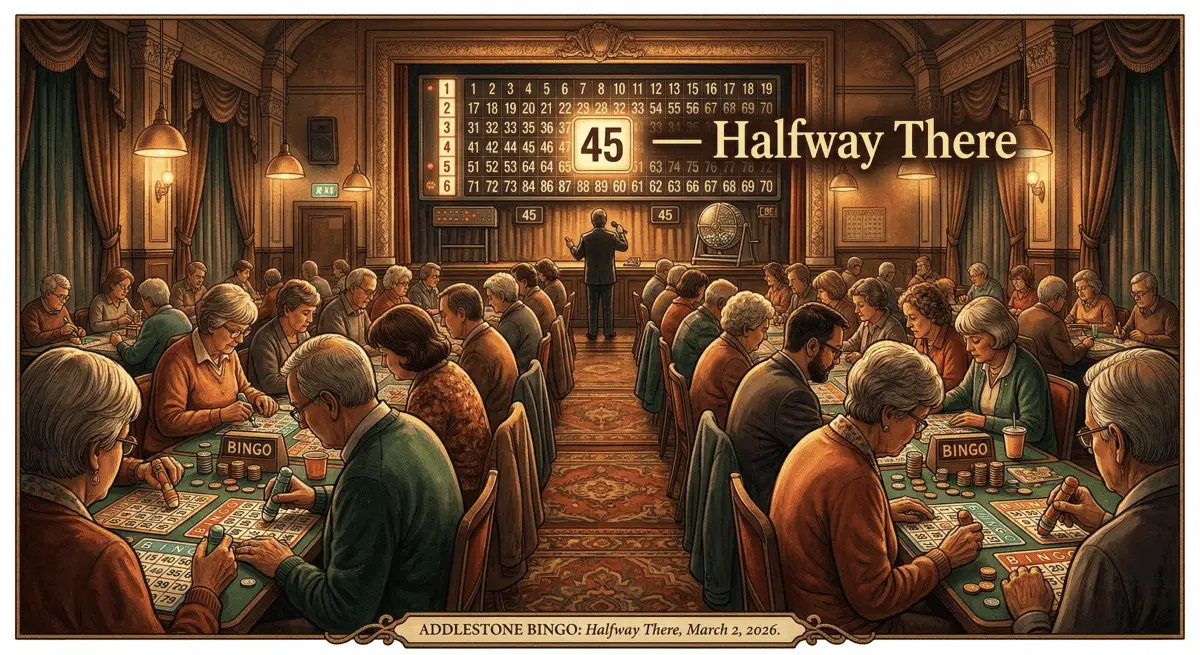
Halfway There, 45 and the Turning Point
Numbers 40–49: Life Begins at Forty
The forties open with one of Britain's most reassuring pieces of folk wisdom and only get more entertaining from there. Winnie the Pooh, four dozen, the old PC49 of BBC radio — this run of numbers spans comedy, culture and nostalgia. Forty-five, the halfway point of the whole game, always gets a moment of acknowledgement. You're halfway there, the hall seems to breathe — and the tension starts to build in earnest.
40 Life Begins
As the saying goes. Forty has long been considered the threshold at which life stops being a rehearsal. The call lands differently depending on whether you're forty or eighty-four.
41 Time for Fun
Rhymes with forty-one. The phrase carries a light, holiday-camp energy, appropriate for a game that exists specifically for leisure.
42 Winnie the Pooh
A.A. Milne's bear of very little brain rhymes perfectly with forty-two. It's one of the calls that genuinely delights children and gets a collective 'aww' from anyone who remembers the books.
43 Down on Your Knees
Rhymes with forty-three. The instruction has a slightly theatrical, pantomime quality. In Catholic communities, it occasionally gets a knowing smile given the association with prayer.
44 Droopy Drawers / All the Fours
Two fours together, all the fours. Or 'droopy drawers', a term for someone whose trousers are perpetually escaping southward. The double meaning is very much intended.
45 Halfway There
The exact midpoint of 1 to 90. This call always gets a response, a collective acknowledgement that the game has reached its turning point and anything can happen in the second half.
46 Up to Tricks
Rhymes with forty-six. The phrase suggests someone getting up to mischief, which in a bingo context usually means marking a number they haven't actually heard called.
47 Four and Seven
A simpler, more literal call, just naming the two digits. Not every number needs a story. Sometimes the plain description is the most dignified approach.
48 Four Dozen
Forty-eight equals four sets of twelve. Practical and satisfying. Some callers add 'eggs' again out of habit.
49 PC / Copper / PC 49
PC 49 was a hugely popular BBC radio detective drama in the late 1940s and early 50s. Constable Archibald Berkeley-Willoughby was the hero, and his badge number gave bingo one of its most fondly remembered calls.
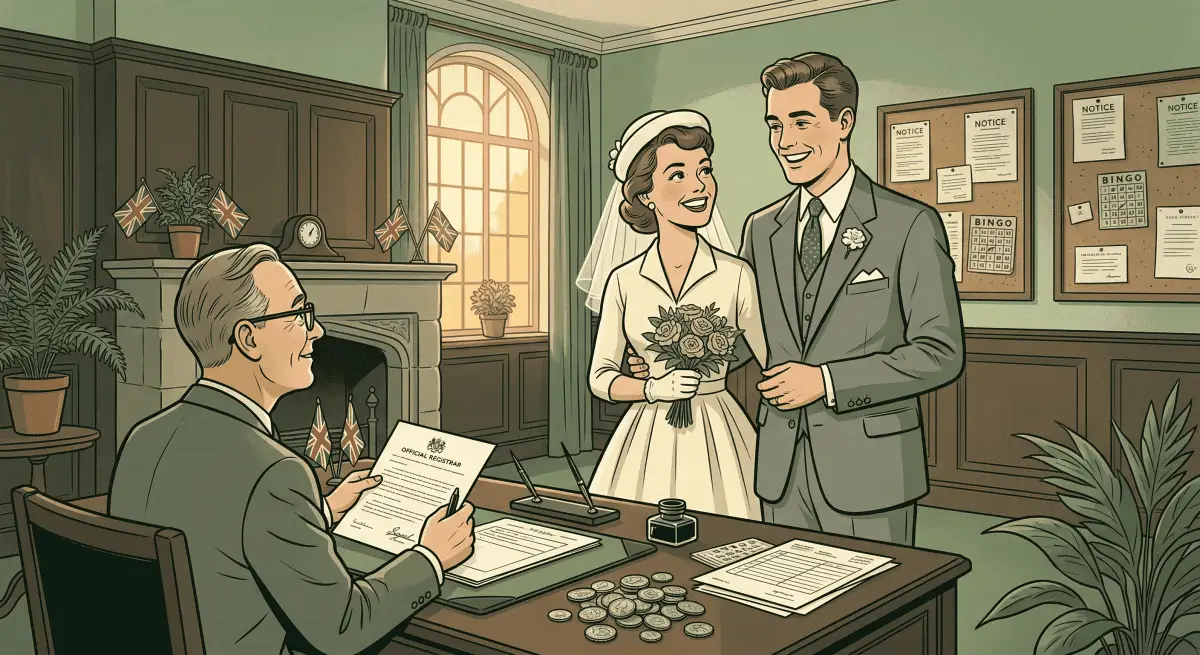
Was She Worth It? The Sixpence Call
Numbers 50–59: Heinz and the Second Half
The fifties are where bingo's relationship with brand Britain becomes unmistakable. Heinz 57 Varieties is one of the most recognised advertising slogans in history, and it sits comfortably among calls referencing drag artists, railway lines and the faded glamour of old marriage licence fees. This decade of numbers is full of character and fifty-five, with two fives together, is always called with double the energy.
50 Half a Century
A cricket term first, scoring fifty runs is a half-century, a genuine personal milestone at the crease. The call carries the same sense of quiet achievement.
51 Tweak of the Thumb
Rhymes with fifty-one. The image of a sharp tweak, the kind a school matron might administer is entirely British in its casual physicality.
52 Danny La Rue
The Irish-born drag artist was one of Britain's biggest entertainment stars of the 1960s and 70s. His name rhymes beautifully with fifty-two, and using it was a mark of affection from a culture that genuinely adored him.
53 Stuck in the Tree
Rhymes with fifty-three. The image of being stuck up a tree is gently absurd, not quite a disaster, but undignified. The call always gets a sympathetic laugh.
54 Clean the Floor
Rhymes with fifty-four. The phrase is domestic, almost mundane, but in a bingo hall, the mundane is often funnier than the grand.
55 Snakes Alive / All the Fives
Two fives side by side, all the fives. 'Snakes alive!' is an old British exclamation of shock, comparable to 'blimey' or 'good grief'. Both calls tend to be delivered with extra volume.
56 Was She Worth It?
One of bingo's most historically specific calls. The marriage licence fee was once five shillings and sixpence, five and six, and the question has been asked ever since. The answer, according to experienced callers, is always yes.
57 Heinz Varieties
Henry Heinz launched his '57 Varieties' slogan in 1896, even though the company made far more than 57 products. He liked the sound of it. So does every bingo caller who's ever had the pleasure.
58 Make Them Wait
Rhymes with fifty-eight. There's a teasing quality to it, as if the caller is deliberately holding something back. In a room full of players one number away from a line, the phrase lands perfectly.
59 Brighton Line
Rhymes with fifty-nine, and the Brighton railway line was one of the busiest and most celebrated routes out of Victorian London. The seaside connection feels appropriate for a game so associated with coastal entertainment.
Clickety Click, All the Sixes
Numbers 60–69: Old Age, Old Pensions and Either Way Up
The sixties bring retirement, Tickety-Boo, and one of bingo's most geometrically satisfying calls. Sixty-five was, for decades, the default retirement age, and the call still lands with a certain mix of wistfulness and relief depending on the audience. Sixty-nine's call is always delivered deadpan, which is the only correct approach. This is bingo doing what it does best: taking the full range of human experience and making it just slightly ridiculous.
60 Five Dozen
Sixty is five sets of twelve. A reliable mathematical call for a number that doesn't carry much other cultural baggage. Clean and dependable.
61 Baker's Bun
Rhymes with sixty-one. A baker's dozen is thirteen, not twelve, the extra bun thrown in for good measure. The phrase carries warmth, the smell of fresh bread, the pleasure of something extra.
62 Tickety-Boo
A marvellous old British phrase meaning everything is perfectly in order. Its origins are disputed, possibly from Hindi, possibly from RAF slang, but it's thoroughly naturalised by now. Delivered with self-satisfied cheerfulness.
63 Tickle Me
Rhymes with sixty-three. The call is an open invitation to light-hearted chaos. In a room full of people who've known each other for years, it always produces a reaction.
64 Red Raw
Rhymes with sixty-four. The phrase suggests something scrubbed too hard or exposed to the elements, very British in its stoic relationship with discomfort.
65 Old Age Pension
For generations, sixty-five was the age at which the state pension began and working life officially ended. The call is still delivered with knowing resonance in halls where the average age is comfortably past it.
66 Clickety Click / All the Sixes
Two sixes side by side, and the sound of a train rattling down the track. 'Clickety click, sixty-six' is one of the most rhythmically satisfying calls in the game, and one of the most recognised.
67 Made in Heaven
Rhymes with sixty-seven. The phrase suggests divine approval, celestial origin, perfect pairing. In bingo terms, it's what players feel when their numbers are coming up in quick succession.
68 Saving Grace
Rhymes with sixty-eight. The theological phrase, a last-minute redemption, the one quality that saves an otherwise unfortunate situation, translates perfectly to bingo, where one number really can change everything.
69 Either Way Up
Sixty-nine looks the same whether you rotate it 180 degrees. The call is made with a straight face. The audience never quite manages the same.
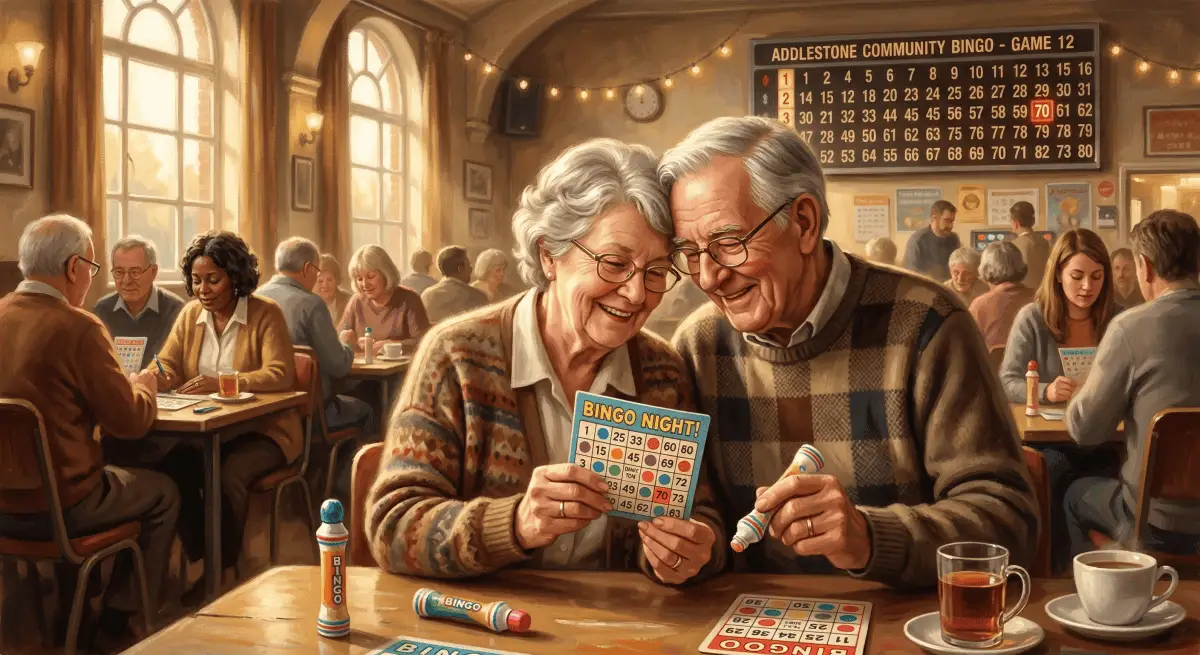
Three Score and Ten, The Weight of Seventy
Numbers 70–79: Three Score and Ten
The seventies open with one of the most resonant phrases in the English language. 'Three score years and ten', the biblical lifespan from Psalm 90, gives number seventy an almost sacred weight. From there the calls move through trombones, sunset strips and cricket, before arriving at seventy-nine where the teens are firmly left behind. By this point in the game, tension is rising; the hall is watchful, pencils poised, hoping
70 Three Score and Ten
From Psalm 90: 'The days of our years are threescore years and ten.' The King James Bible gave us the phrase; British bingo gave it new life every evening. Called with genuine gravity.
71 Bang on the Drum
Rhymes with seventy-one. The phrase suggests a decisive, unambiguous statement, bang, right on target. Callers sometimes add a tap on the podium for emphasis.
72 Six Dozen
Seventy-two is six sets of twelve. One of the purely mathematical calls that exist simply because not every number needs a nickname.
73 Queen Bee
Rhymes with seventy-three. The queen bee imagery, industrious, central, absolute authority within her domain is quietly flattering. Popular with callers who know their audience.
74 Hit the Floor
Rhymes with seventy-four. The phrase has dancefloor energy, disco-era associations though in a traditional bingo hall it tends to produce a wry smile rather than any actual movement.
75 Strive and Strive / Big Daddy
Shirley Crabtree, Big Daddy was one of British wrestling's greatest characters in the 1970s and 80s. Enormous, white-haired, audience-adored. His number was 75, and the call still gets a cheer from anyone old enough to remember him.
76 Trombones
Meredith Willson's 1957 musical The Music Man opens with '76 trombones led the big parade.' The image of a brass band marching through a bingo hall is unlikely, but the call has endured.
77 Sunset Strip / Double Hockey Sticks
77 Sunset Strip was an American TV detective show of the late 1950s, enormously popular in Britain. Two 7s side by side also resemble a pair of hockey sticks, hence the alternative call.
78 Heaven's Gate
Rhymes with seventy-eight. The phrase invokes the ultimate threshold, appropriate for a game where you're always one number away from something wonderful.
79 One More Time
Rhymes with seventy-nine. 'One more time' is the eternal bingo request, one more number, one more chance, just once more. Called with pleading energy.
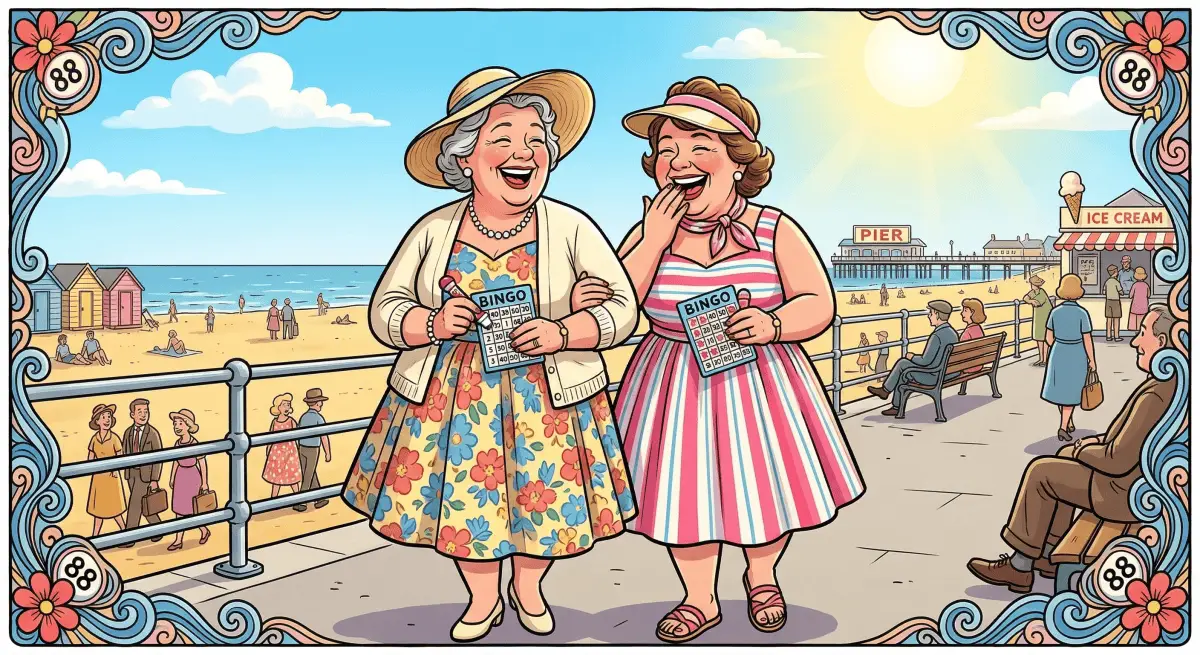
Two Fat Ladies, Bingo's Most Famous Call
Numbers 80–89: Nearly There
The eighties are where bingo's calls take on a certain weight, not because they come last, but because of what they represent. Eighty-eight, Two Fat Ladies, is arguably the most famous call in the game: two rounded figures side by side, announced with theatrical relish in halls up and down the country. Eighty-nine, Nearly There, has a teasing quality that works whatever the context, one away from the top of the board, one away from a full set of tens, always tantalisingly close to something. This is also the decade that gives us Staying Alive, Gandhi's Breakfast and a nod to Torquay's quiet ambitions as the English Riviera. The eighties are a rich, characterful run of calls that hold their own at any point in the game.
80 Eight and Blank / Gandhi's Breakfast
Two-digit description of 8 and 0. The more colourful alternative, Gandhi's Breakfast, refers to the Mahatma's famous fasting practice. An 8 and nowt, as some callers put it. Usually delivered with a grin.
81 Stop and Run
Rhymes with eighty-one. The contradiction is deliberate, stop or run? Indecision in the face of good fortune is very relatable in a bingo hall.
82 Straight on Through
Rhymes with eighty-two. The phrase suggests momentum, purpose, no detours, the kind of clear run to the finish line every bingo player dreams of.
83 Time for Tea
Rhymes with eighty-three. British timing: even with two numbers to go for a full house, the kettle calls. Tea solves everything, including the tension of almost winning.
84 Seven Dozen
Eighty-four equals seven sets of twelve. A mathematical call for a number that prefers clean arithmetic to cultural embellishment.
85 Staying Alive
The Bee Gees' 1977 disco anthem gives this number its soundtrack. By the time 85 is called in a live game, the phrase resonates, staying alive in the game, one number from glory.
86 Between the Sticks
A football term for the goalkeeper's position, between the goalposts. Eighty-six rhymes with sticks, and the sporting reference is typically delivered with authority.
87 Torquay in Devon
Rhymes with eighty-seven. Torquay's reputation as the English Riviera, slightly aspirational, unmistakably English, gives the call a gentle holiday atmosphere at the tensest point in the game.
88 Two Fat Ladies
The most celebrated call in British bingo. Two 8s side by side, like two rounded figures seated together. The call is always drawn out, 'eighty-eight... two fat ladies' with theatrical relish. Audiences often respond audibly.
89 Nearly There / Almost
By far the most agonising call in the game. Eighty-nine means one more number stands between you and 90 on a full card. Called slowly, with awareness of the torture being administered.
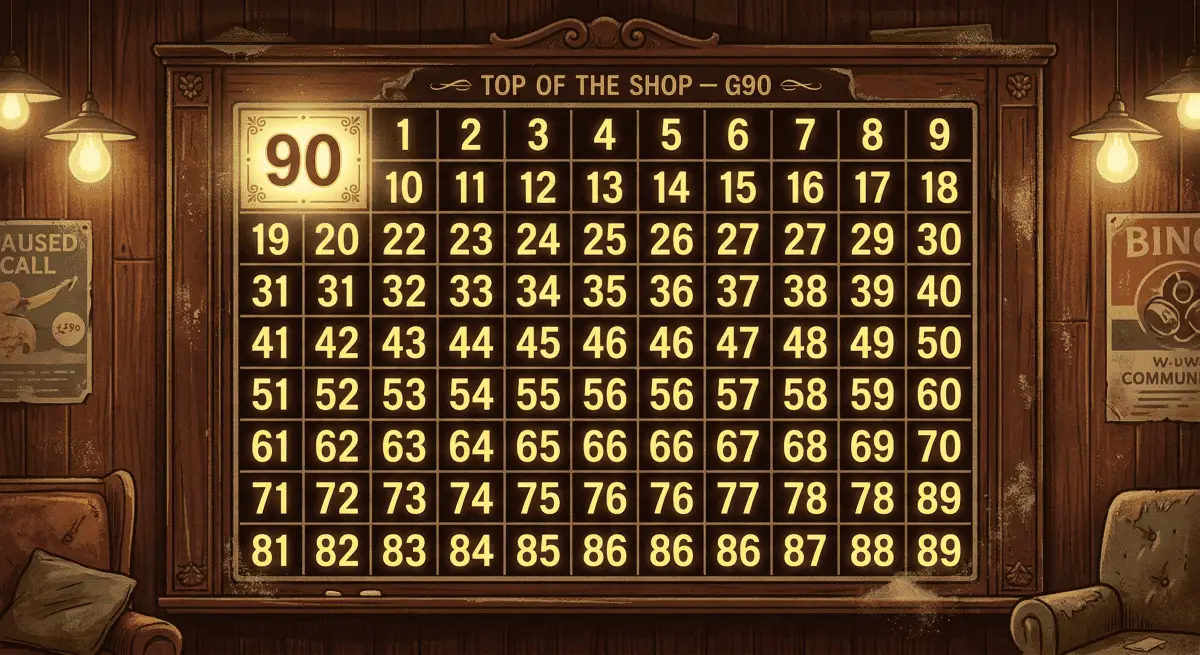
Top of the Shop, Britain's Highest Bingo Number
Number 90: Top of the Shop
Ninety sits at the top of the board, but that's where its special status begins and ends. Like every other number in the game, it can come up first or last, early or late, bingo doesn't save its biggest number for a grand finale. What makes 90 distinctive is simply that it's the ceiling: the highest possible call, the one that completes the full set. Top of the Shop is the call, and it's delivered with a certain satisfaction, not because it ends anything, but because there's something pleasing about reaching the top of the range. For the caller, it's a moment of mild ceremony. For the players, it's just another number, one that might be exactly what they need, or might mean nothing at all. That's bingo.
90 Top of the Shop
The highest number on the board, and nothing more or less than that. Ninety sits at the top of the range, hence Top of the Shop, but it carries no special power in the game itself. It can be the very first ball out of the cage or the very last; it can win someone a full house or sit unmarked on a card all night. What it does have is a certain satisfying finality as a call, the caller announcing that the board goes no higher, that this is as far as the numbers go. In a game built on anticipation and chance, ninety is simply the lid on the tin.